
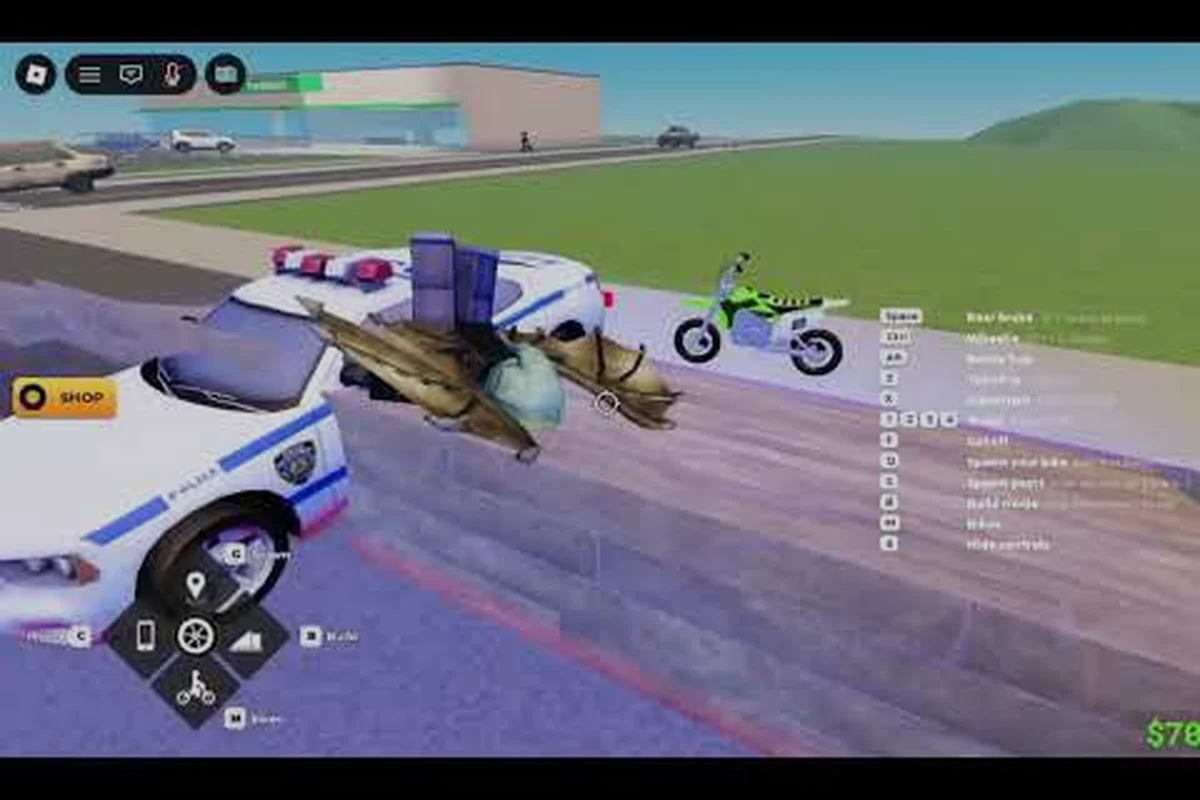
Drop into Bike Universe, roll out on the free starter bike, and start stacking cash through riding and wheelies — that single loop covers roughly your first 10 minutes. Knowing what to do first in Bike Universe saves you from wandering the open world with no direction, because the game hands you movement, a starter bike, and a clean cash economy in your first spawn instead of gating progress behind quests. The map is wide, the bike families are many, and the money ticks up while you ride, so the smartest first move is to get rolling immediately and learn the income basics before you spend anything.
This Bike Universe new player guide walks through your first spawn, the controls, the cash loop, and the smartest early upgrades so you start the game with momentum instead of confusion. You'll also pick up the wheelie timing that separates casual riders from serious earners, plus a quick map of which bike families to chase first and which ones to leave alone until you have a real cash reserve.
Your First Spawn and the Free Starter Bike
Spawning into Bike Universe is intentionally friction-free: the game drops you on a free starter bike in the open world with no required tutorial, so the first 30 seconds are about getting a feel for movement, throttle, and balance rather than reading walls of text. According to the official game page, the experience is a vehicle-simulation sandbox where riders cruise an open-world map, collect Dirt, Electric, and Pedal bike families, and earn cash from riding, wheelies, and tricks. The Roblox listing also reports roughly 13.1M+ visits, 48.9K active players, and 38K+ favorites on a late-September 2026 snapshot, with full support for Desktop, Console, Mobile, and Tablet — meaning your device choice does not block early progress.
That free starter bike is your training tool, not your long-term ride. Community creators including Radex Tips and TonyCool both open their beginner guides by treating the starter as a throwaway: ride it, learn the throttle-brake feel, get your first wheelie down, and start banking cash so you can move into a real bike family within your first session. The starter's job is to teach you the cash economy, not to carry you to the endgame.
What the Starter Bike Teaches You
The starter bike is slow, light, and stable — which is exactly why it works for learning. You can hold a wheelie for a long stretch on flat ground, and you can crash without losing much, so the failure cost while you figure out the trick timing is close to zero. Community testing in Reddit's r/Roonby guide and on TonyCool's walkthrough consistently recommends spending your first 5–10 minutes on this bike specifically to practice:
-
Throttle-brake rhythm for tight corners and obstacle dodges
-
Wheelie hold timing for cash multipliers
-
Lean control for downhill sections
-
Trick input sequencing before you risk a faster, harder-to-control bike
Once you can hold a wheelie on the starter without falling, the next jump to a faster bike is significantly less punishing because the heavy jump in power-to-weight ratio, top speed, and braking distance punishes riders who still wobble on throttle release. The starter keeps acceleration low enough that a missed wheelie costs you maybe 2–3 seconds of recovery; mid-tier bikes double that penalty and can launch you into a wall if your brake timing is off by a frame. Spending the first 5–10 minutes locking in wheelie hold timing on the starter means the cash multipliers you banked actually transfer to the next bike instead of vanishing into a respawn. This progression ladder is the same one the r/Roonby guide and TonyCool walkthrough both walk players through, so treat the starter as a calibration tool rather than a throwaway ride.
The Core Cash Loop: Ride, Wheelie, Repeat
Bike Universe's economy runs on a single core loop: ride continuously to earn baseline cash, layer wheelies and tricks on top to multiply that income, and bank the result before spending on upgrades or a new bike. According to the official Roblox game page, the cash sources that matter most for new players are riding income, wheelie income, and trick income, with all three running in parallel while you move. That means every second you spend rolling is earning something — there is no AFK money trick, so the best strategy is to keep riding while also learning to chain wheelies because that combo is where the real per-minute income lives.
The Radex Tips beginner guide explicitly frames the early game as a "fast money" phase, because the gap between riding-only cash and riding-plus-wheelies cash is large enough to change which bike family you can afford in your first hour. TonyCool's walkthrough reaches the same conclusion from a different angle: he ranks coin-earning methods by per-minute yield and puts steady riding plus a sustained wheelie at the top of the list, well ahead of stationary grinding or random pickups.
Cash Sources Ranked by Reliability
| Cash Source | Reliability | Skill Required | Best Use Case |
|---|---|---|---|
| Steady riding | Very high | None | Passive baseline while exploring |
| Wheelies on flat ground | High | Low–medium | Main multiplier for new players |
| Trick chains | Medium | Medium | Mid-game income spike |
| Pickup collection | Low | Low | Supplemental, not a primary path |
| Event bonuses | Variable | Variable | Seasonal spikes, not core loop |
The table matters because new players often waste time chasing pickups or sitting in spawn hoping for a payout, when the most reliable strategy is simply to ride well and hold wheelies. The economy rewards movement and balance, not menu optimization.
Controls and Movement Basics to Lock In Early
Before you start chasing any bike family, lock in the control scheme Bike Universe gives you by default. Because the game can be played on desktop computers, consoles, mobile phones, and tablets, the actual input mapping shifts per platform, but the underlying mechanics — throttle, brake, lean, wheelie input, and trick input — are the same across all of them. The community guides from Radex Tips and TonyCool both stress that riders who internalize these five mechanics in the first session make more money in their second session than riders who skip straight to bike shopping.
The Five Mechanics That Matter
| Mechanic | What It Does | Early-Game Priority |
|---|---|---|
| Throttle | Accelerates the bike | High — required for all income |
| Brake | Slows the bike | High — needed for tight turns |
| Lean | Shifts balance left/right | High — required for wheelies |
| Wheelie input | Lifts front wheel | High — main cash multiplier |
| Trick input | Triggers mid-air stunts | Medium — payoff grows later |
Lean and wheelie input are the two mechanics most new riders underestimate. The Radex Tips video specifically calls out that a clean lean-and-hold pattern is what separates a player earning baseline cash from a player earning wheelie-multiplied cash, and the difference shows up within minutes, not hours. If you can hold a wheelie for 5–10 seconds without dropping it, your per-minute income roughly doubles compared to a riding-only pace.
Platform-Specific Notes
On Desktop, throttle and brake map to keyboard or controller by default, and the wheelie input is a single key that you hold to lift the front wheel. On Console, the same controls map to the triggers and a face button, and on Mobile/Tablet the inputs appear as on-screen buttons. The mechanic is the same on all four platforms, but the muscle-memory curve is steepest on Mobile because the on-screen layout eats screen real estate — community testing on Reddit and YouTube comments suggests new mobile players should expect a short adjustment period before they can hold a clean wheelie.
Smart Early Spending: Where Your First Cash Goes
Once you have a small cash reserve — anywhere from a few minutes to half an hour of riding depending on your wheelie consistency — the question becomes what to spend it on. Bike Universe has multiple bike families (Dirt, Electric, and Pedal are the three core families highlighted on the official page), plus upgrades and customisation options that all compete for the same wallet. The starting guide strategy is to pick one bike family and one meaningful upgrade and ignore the rest until that purchase has paid for itself.
The most common early-spending mistake, flagged by both Radex Tips and TonyCool, is to spread your first cash across several small upgrades instead of committing to a single bike that meaningfully outperforms the starter. A faster, better-handling bike multiplies all of your income because it lets you cover more ground per minute and hold wheelies on terrain the starter cannot manage. The Bike Universe economy guide breaks down the same point with more numbers, but the core idea is identical: early cash converts faster into one good bike than into many small upgrades.
Spending Priority Tiers
| Tier | Spend Target | Why It Pays Off |
|---|---|---|
| First | One bike in your chosen family | Multiplies all income sources |
| Second | Engine or speed upgrade on that bike | Increases per-minute riding cash |
| Third | Visual customisation | Pure preference, no cash benefit |
| Hold off | Multiple cheap bikes | Splits your upgrade progress |
| Hold off | Premium event items | Outclassed by the next bike family |
Riders who follow a tier-list approach like this consistently reach their second bike family faster than riders who buy reactively. The Radex Tips beginner guide specifically recommends treating your first real bike purchase as a "milestone" rather than a casual expense, because everything in Bike Universe's economy compounds once you have a competent bike underneath you.
Bike Families to Chase First (and Which to Skip)
Bike Universe groups its bikes into three core families — Dirt, Electric, and Pedal — each with a different handling profile and a different best-use case. According to the official Roblox game page, these are the families new riders collect first, and the order in which you tackle them has a significant effect on how fast your income grows. Radex Tips frames the early-game bike choice as the single biggest lever a new player has, because the family you pick determines which terrains and which wheelie patterns you can sustain. Radex Tips frames the early-game bike choice as the single biggest lever a new player has, because the family you pick determines which terrains and which wheelie patterns you can sustain, and the Bike Universe Beginner Guide maps each starter family to its ideal route, surface mix, and pump/wheelie rhythm so you can translate that choice into faster, steadier income growth from your very first races.
According to the official Bike Universe page, new players should first focus on spawning in and getting familiar with the basic bike controls before attempting any advanced tricks or multiplayer races.
Dirt Bikes
Dirt bikes are the most beginner-friendly family in Bike Universe. They handle rough terrain well, hold wheelies predictably on flat ground, and cost less than Electric bikes in most community-tested price points. The trade-off is a lower top speed than Electric, which means slightly less per-minute riding cash on long straightaways. For a new player whose first goal is to learn the cash loop without crashing constantly, Dirt is the safest first purchase.
Electric Bikes
Electric bikes are the speed-focused family. They accelerate faster, reach a higher top speed, and therefore generate more riding cash per minute on open stretches. The trade-off is harsher handling — Electric bikes punish sloppy leans and break wheelie holds more easily than Dirt bikes, so they reward players who have already practiced the mechanic on a starter. Community testing on TonyCool's channel and the Reddit guide both suggest Electric as the second-family purchase, after you have built wheelie consistency.
Pedal Bikes
Pedal bikes are the trick-focused family. They have the lowest top speed of the three but the best trick-input responsiveness, making them the strongest choice for players who want to build a chain-trick income path instead of a wheelie-income path. For a pure beginner, Pedal is harder to optimise because trick chains require more precise inputs than wheelies, so most community guides recommend leaving Pedal for your third family or later.
| Family | Strength | Weakness | Best Rider Profile | Recommended Order |
|---|---|---|---|---|
| Dirt | Stability, low price | Lower top speed | Wheelie learners | First |
| Electric | Speed, high riding cash | Harsh handling | Confident riders | Second |
| Pedal | Trick responsiveness | Lowest speed | Trick specialists | Third or later |
This ranking matches the sequence both top community resources push: Radex Tips' beginner video and TonyCool's walkthrough independently land on Dirt → Electric → Pedal as the optimal progression. The reasoning lines up with the trade-offs in the table above — Dirt gives you cheap stability to learn wheelie timing, Electric's harsher handling is easier to absorb once you already have cash flow, and Pedal's trick-input precision is wasted on a rider who hasn't banked enough riding cash to absorb the longer optimisation curve. Sticking to this order is what most new-player guides use as the default Bike Universe starting path before any off-meta experimentation.
Common First-Session Mistakes to Avoid
Even with a clean starting guide, new players fall into a handful of predictable traps during their first session in Bike Universe. The community guides from Radex Tips, TonyCool, and the r/Roonby Reddit post all flag the same handful of mistakes, and avoiding them is worth more than any single upgrade you can buy. Most of these traps come from treating Bike Universe like a traditional progression game with quests, instead of a vehicle-simulation sandbox where the economy rewards consistent riding.
The first trap is grinding stationary cash sources (pickups, parked positions) instead of riding. The game's economy is built so that cash accrues while you move, so the most efficient grind is a long, flat, wheelie-friendly route that you can repeat. The second trap is buying visual customisation before you have a competent bike, which burns cash on cosmetics that do not multiply your income. The third trap is switching bike families every time you see a new model, which fragments your upgrade progress and slows your long-term growth.
Quick Mistake Checklist
-
Riding without a wheelie input attempt on flat ground
-
Spending first cash on cosmetic items
-
Jumping to Electric before practising on the starter
-
Grinding stationary pickups instead of routing
-
Chaining multiple cheap bike purchases instead of one solid upgrade
Riders who consciously avoid these patterns in their first session typically reach their second bike family in roughly the time it takes other riders to fully customise their starter, because each avoided mistake preserves cash and XP that would otherwise be sunk into cosmetic reskins, redundant cheap bike rebuys, or premature Electric-class jumps that skip the wheelie and ground-pickup fundamentals learned on the starter. By skipping stationary grinding in favour of routed pickups and attempting at least one wheelie input on flat ground, a new player converts early-session time into measurable progression speed rather than inventory clutter, which directly shortens the gap to the second bike family in the Bike Universe progression order.
Frequently Asked Questions
What should I do first when I spawn into Bike Universe?
Stay on the free starter bike, ride for 2–3 minutes to learn the throttle and brake feel, then start practicing wheelie holds on flat ground. Cash begins accruing the moment you spawn, so movement is the priority — your first real upgrade should come after you can hold a clean wheelie, not before.
How do I earn cash the fastest as a new player?
Combine steady riding with sustained wheelies on flat terrain. Riding alone gives you baseline income, and a held wheelie multiplies that income for as long as you keep the front wheel up. The Radex Tips beginner guide and the community Reddit post both rank this combo as the highest per-minute path for new riders.
Which bike family should I buy first — Dirt, Electric, or Pedal?
Start with Dirt. It is the most beginner-friendly family, handles rough terrain well, and lets you hold wheelies more predictably than the other two. Save Electric for your second family once your wheelie timing is consistent, and leave Pedal for later when you want to focus on trick chains.
Can I play Bike Universe on mobile or console?
Yes. According to the official game page, Bike Universe is available on desktop computers, consoles, mobile phones, and tablets, so the platform you pick does not block early progress. The mechanics are the same across platforms, but the muscle-memory curve for wheelie timing is steepest on Mobile because the on-screen control layout takes some getting used to.
Do I need to join the developer group to play Bike Universe?
No, joining the group is optional. The Bike Universe developer group on Roblox is the main channel for official announcements and community activity, but the game itself is fully playable without joining. New players who want patch notes and event news often join the group as a low-effort way to stay informed, but it is not a gameplay requirement.